EXECUTIVE DECISION™
FRAMEWORK
Why Executive Decision Matters.
The answer is rarely the strategy itself. Organizations fail because leaders cannot consistently see reality, make difficult decisions, and execute those decisions across the enterprise.
Most executive frameworks move directly from Strategy to Execution. The space between — visibility, governance, and decision quality — is where transformations succeed or fail. It is where I have spent my career.
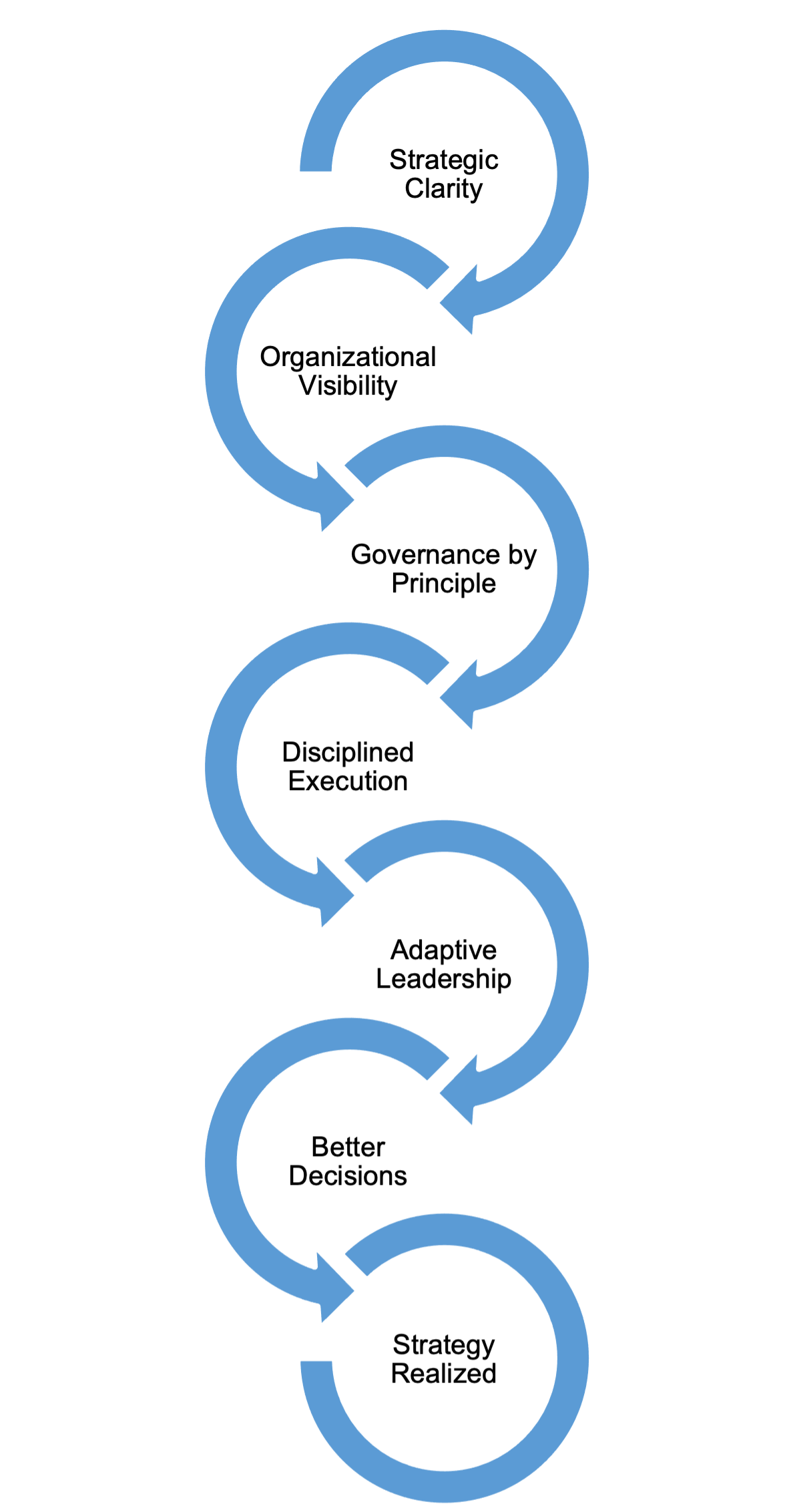
Executive Decision Architecture:
From Strategy to Results
Through Better Executive Decisions
Pillar 1
Strategic Clarity — What are we trying to accomplish?
Most organizations have too many priorities.
Creating clarity around: Strategic objectives, Business outcomes, Success measures, Executive alignment, Portfolio prioritization
Philosophy: "Executives deserve focus."
Deliverable: A leadership team aligned around a single strategy, not competing agendas.
Pillar 2
Organizational Visibility — What is actually happening?
Executives often decide with incomplete, delayed, or biased information.
Creating enterprise visibility through: Portfolio transparency, Metrics that matter, Financial visibility, Risk visibility, Independent Validation & Verification (IV&V), Honest reporting — not optimistic reporting
Philosophy: "Executives deserve the truth early."
Deliverable: A leadership team that receives the truth in time to make effective decisions.
Pillar 3
Governance by Principle — How are decisions made?
Governance isn't bureaucracy — it's built on principles rather than personalities.
Creating governance through: Principles that endure, Quality decisions, Eliminated ambiguity, Accountability, Accelerated execution
Philosophy: "Governance is a decision system."
Deliverable: A governance operating system for the enterprise.
Pillar 4
Disciplined Execution — Can the organization consistently deliver?
Most organizations confuse activity with results.
Improving execution through: Enterprise PMO, Product delivery, Resource optimization, Financial management, Change management, Operational rhythm
Philosophy: "Activity does not equal execution."
Deliverable: Execution with predictable delivery.
Pillar 5
Adaptive Leadership — Can the organization continuously improve?
Every transformation changes the business.
Improving adaptation through: Knowledge management, Leadership development, Organizational maturity, AI adoption, Iterative adaptation
Philosophy: "Transformation becomes a capability — not an event."
Deliverable: Adaptive leadership and transformation capabilities.
How I Use the Framework:
The Executive Decision™ Framework is not an additional process imposed on the organization. It is a mechanism for aligning executive teams and stakeholders around the work already underway, ensuring efforts remain focused on strategic outcomes.
The framework establishes a common operating cadence: clarifying strategic priorities, creating visibility across portfolios and functions, defining decision rights and escalation paths, driving accountability for execution, and enabling agile adjustments as conditions change.
The objective is not additional bureaucracy. It is to give leadership a unified view of reality, ensure decisions are made at the appropriate level, and keep teams aligned as strategy moves through execution.
The Executive Promise
Everything ultimately delivers three outcomes:
● Executives see reality sooner — through enterprise visibility
● Executives make better decisions — through governance and disciplined decision-making
● Organizations execute with confidence — through structured execution and change leadership